Monday, July 25, 2011

3 Steps To Weight Loss


Hey there. I hope you have having a great day so far. I wanted to share some insight with you that I have had during my latest 8 week body transformation challenge. We are currently in the 6th week and I am really excited with the progress everyone has made. We are really seeing some great transformations!

I am definitely beginning to see a trend with people who are the most successful with their weight loss, whether it be from these challenges, or just in general from other clients I work with. Here are the 3 MOST important things you must do before you will lose 1lb. None of these involve exercising or nutrition. Obviously those are huge aspects of the program, but before you even think about working out or dieting, you must do these 3 things:

1. Have a plan.

The good thing with diet and exercise is there are plenty of choices out there. We just need to figure out exactly what you are going to need to do to lose weight. This will be different for everyone. What is the same though, is that everyone must do something different to see a change in their body. If you are trying to lose weight we need a game plan to follow. Think about anything else you want to accomplish in life. How much easier is it if you follow instructions, instead of just figuring it out as you go? Yes I am guilty of throwing out directions and trying to put something together on my own. Ask my wife how that usually goes...

It always helps to have a professional put together a program for you but many of these things you can plan yourself. You must know exactly what type of nutrition program you want to follow and how you are going to increase your activity level. Once you have your plan, you need to schedule it out. Make note of what days you will workout, what day you will start, and what day it will end. Having an end date is critical. You may not reach your goal by the end date, but that is the time you can evaluate how your plan has worked. If it is going great you might continue on with it and create a new end date.

2. Surround Yourself With Good Influences:

There are many studies that have proven, we are very similar to our circle of influences. We tend to be just like the people we associate with. If they are overweight then you will most likely be overweight. There are many, many negative people out there that will try and drag you down. If they can't accomplish something, then they may not want you to be successful either. Make sure the people you are hanging out with are going to support you 100%. If someone is just draining your energy, it is time to decrease the time you spend with them.

3. Believe You Can Do It!

I know this might sound cheesy, but it is true. A few years ago I wouldn't even think about something like this. You just exercise and eat right and you lose weight. I never really realized how powerful the mind and your subconscious can be. When I think back to my high jumping days in college though, this was exactly what I did. I would go to a competition knowing that I would be successful and knowing that I was going to win. And because of this (and my training) I was very successful.

If you do not believe you can lose weight, you will not. If you feel like you are cursed and will just be overweight forever, then you will. We tend to look at others and say how lucky some people are. Ask the most successful people in the world if they got there by luck. Hard work and truly believing you will achieve your goal is what will bring success. Don't look for the easy way out. There is none. Instead of thinking how nice it would be if you lost weight or hit your goal, think how good it is GOING to be when you get there.

Well that is my motivational talk for the week. Now stop reading and get started on your plan.

You stay healthy San Diego!

Mike Deibler MS, CSCS
San Diego Premier Training
My Workout Creator

Wednesday, July 13, 2011

Newest ACSM Position Statement


The American College of Sport Medicine is one of the leading authorities in the health and fitness industry. The ACSM promotes and integrates scientific research, education, and practical applications of sports medicine and exercise science to maintain and enhance physical performance, fitness, health, and quality of life. The ACSM sets the standard for minimum exercise for increasing healthy lifestyle.

When new research arises they update their position on what type and amount of exercise should be performed. Below is their recommendation for quality and quantity of exercise. This list is not for athletes. This is what is recommended for the average person who is able to exercise. Check this list and see how you compare. If you are performing less than this and are not happy with your weight or fitness level then it is time to step it up.

Cardiorespiratory Training:
  • Adults should get at least 150 minutes of moderate-intensity exercise per week.
  • Exercise recommendations can be met through 30-60 minutes of moderate-intensity exercise (five days per week) or 20-60 minutes of vigorous-intensity exercise (three days per week).
  • One continuous session and multiple shorter sessions (of at least 10 minutes) are both acceptable to accumulate desired amount of daily exercise.
  • Gradual progression of exercise time, frequency and intensity is recommended for best adherence and least injury risk.
  • People unable to meet these minimums can still benefit from some activity.
Resistance Exercise:
  • Adults should train each major muscle group two or three days each week using a variety of exercises and equipment.
  • Very light or light intensity is best for older persons or previously sedentary adults starting exercise.
  • Two to four sets of each exercise will help adults improve strength and power.
  • For each exercise, 8-12 repetitions improve strength and power, 10-15 repetitions improve strength in middle-age and older persons starting exercise, and 15-20 repetitions improve muscular endurance.
  • Adults should wait at least 48 hours between resistance training sessions.
Flexibility Exercise:
  • Adults should do flexibility exercises at least two or three days each week to improve range of motion.
  • Each stretch should be held for 10-30 seconds to the point of tightness or slight discomfort.
  • Repeat each stretch two to four times, accumulating 60 seconds per stretch.
  • Static, dynamic, ballistic and PNF stretches are all effective.
  • Flexibility exercise is most effective when the muscle is warm. Try light aerobic activity or a hot bath to warm the muscles before stretching.
Neuromotor Exercise:
  • Neuromotor exercise (sometimes called “functional fitness training”) is recommended for two or three days per week.
  • Exercises should involve motor skills (balance, agility, coordination and gait), proprioceptive exercise training and multifaceted activities (tai ji and yoga) to improve physical function and prevent falls in older adults.
  • 20-30 minutes per day is appropriate for neuromotor exercise.

I know this seems like a lot of exercise to be a minimum, but all of these can be combined to create more efficient workouts. It is not necessary to workout every single day to achieve these goals.

The workouts that we create at San Diego Premier Training keep this in mind. We know that most people are just too busy to be working out all the time. Instead we create workouts that involve Cardiorespiratory training, resistance training, flexibility, and functional training all in one. You time is precious so the less time you spend exercising the more time you have for other things.

Try one of our workouts out for free. Just visit www.sandiegopremiertraining.com and click on the free workout button to get started.

You Stay Healthy San Diego,

Mike Deibler MS, CSCS
San Diego Premier Training

Wednesday, July 6, 2011

Brand New Weight Loss Studies

Hi there. I hope you are having a great week and are starting to recover from the holiday weekend.

Chances are you put on a few pounds this weekend and are ready to get them off as fast as possible, along with maybe a few more unwanted pounds. I just came across a few great studies in the latest American Journal of Clinical Nutrition that may help you get rid of some unwanted fat or just help you get on a healthy path.

Study 1: Short sleep duration increases energy intakes but does not change energy expenditure in normal-weight individuals

This title pretty much sums up the entire study. Here researchers took a group of individuals and compared their diet and energy expenditure after habitual 4hr of sleep per night and 9hr per night. What they found that participants were eating about 300 calories more per day on less sleep and especially increased their fat intake. The real problem is they did not increase their energy expenditure at all on days they ate more. So this group would gain about a 1lb every 10 days or 30lbs in a year if they were to continue this habit.

This can be an easy fix. Make sure you are getting adequate sleep every night to avoid increased calorie consumption.

Study 2: Green tea intake lowers fasting serum total and LDL cholesterol in adults: a meta-analysis of 14 randomized controlled trials

Again the title says it all here. In this study researchers wanted to look at green tea's effect on cholesterol levels. Green tea has already shown many great health benefits including possible increased fat burning. This study reviewed 14 eligible randomized controlled trials using green tea. They found that through all of these studies, 1136 subjects, there was a significant reduction in total cholesterol and LDL levels. There was no effect on HDL levels, however.

Study 3: Cruciferous vegetable consumption is associated with a reduced risk of total and cardiovascular disease mortality

And our final study involves vegetable consumption, which I know most people tend to struggle with. Asian populations tend to consume large amounts of cruciferous vegetables and other plant based foods. This study wanted to determine the effects of a diet high in these cruciferous vegetables. This is just a family name for certain vegetables. Some of the more popular ones are kale, collard greens, cabbage, brussel sprouts, cauliflower, and broccoli.

This study observed women for 10 years and evaluated diet program. They found that those who consumed higher cruciferous vegetables and fruits lived longer and were less likely to suffer from cardiovascular disease.

I know these three studies are a little random but I thought they are very useful tips for anyone trying to live a healthier lifestyle. Key points:

1. Sleep more
2. Drink Green Tea
3. Eat more vegetables

You stay healthy San Diego,

Mike Deibler MS, CSCS
San Diego Premier Training
My Workout Creator

Tuesday, June 21, 2011

Vitamin D Levels And Postmenopausal Women


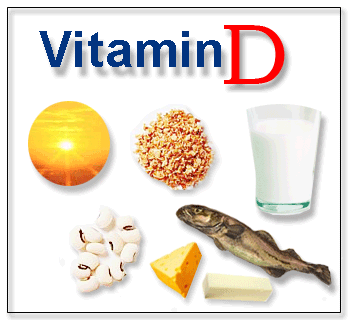
Vitamin D has gotten more and more attention in the health industry and for good reason. Vitamin D is a fat soluble vitamin that is responsible for regulating calcium amounts in the blood, plays a role in growth and remodeling of bone, reduces cardiovascular disease, improve your immune system, reduces your risk of certain cancer, improve skin complexion, prevents muscle tension, and aid with weight loss just to name of few benefits.

More people are realizing that they actually have a Vitamin D deficiency. Vitamin D can be found in foods such as milk, fish, mushrooms, and eggs or taken as a supplement. Vitamin D is also produced in the skin when you are exposed to UV rays from the sun or from an artificial source. You may become deficient if you:

1. Don't consume the recommended levels through food or supplementation.
2. Do not have enough exposure to sunlight.
3. Do not have dark skin complexion.
4. Have kidney problems and cannot convert Vitamin D to its active form.
5. Cannot adequately absorb Vitamin D through your digestive tract.
6. Are Obese.

Even if you do not fit in any of these categories it is still a good idea to regularly have your blood tested to determine your Vitamin D levels. I actually had mine tested and found that my levels were on the low side.

A recent study looking at overweight postmenopausal women found so very exciting news on the vitamin. The study took a group of women and divided them into 4 groups. A diet only group, an exercise only group, a diet and exercise group, and a control group. The study found that no matter how you did it (exercise, diet, or both) those that lost weight saw an increase in Vitamin D levels. In fact, women who lost <5%, 5–9.9%, 10–14.9%, or ≥15% of baseline weight had mean increases in Vitamin D levels of 2.1, 2.7, 3.3, and 7.7 ng/mL, respectively.

So if you have never check your levels I highly recommend looking into it. If they are low there are plenty of things you can do to increase them. Start with a diet high in Vitamin D and exercising in the sunshine. Catch this problem before you experience any of the symptoms of Vitamin D deficiency.

You Stay Healthy San Diego,

Mike Deibler MS, CSCS
San Diego Premier Training

Wednesday, June 15, 2011

Change Your Metabolism

When talking fat loss, we hear the word metabolism get thrown around. You might hear that certain foods or supplements boost your metabolism or that as you age your metabolism will slow down. There are a lot of claims out there that probably can't be back up very well, but one thing is for sure. Your metabolism play a vital role with weight loss.

I read a great article by Dr. Len Kavitz (no not the singer) that really did a great job summing up metabolism. Here are some pieces from that article.

First we need to look at what is your metabolism. Your metabolism is basically the sum of all the chemical reactions in your body. It requires energy for these reactions to take place. This energy comes from calories. So if you have a higher metabolism you burn more calories. This is why it is so important for weight loss. When we look at how many calories you burn during the day, about 60% comes from you Resting Metabolic Rate (RMR). The rest comes from the thermic effect of exercise and spontaneous activity (30%), and the thermic effect of food metabolism (10%). So you can see your metabolic rate plays the biggest role in burning calories. So it is simple... To lose more weight keep your RMR high. Below are some things to consider to keep that metabolism burning:

Diets will slow down your metabolism.
By decrease what you eat you are actually slowing down your metabolism. This is very hard for people to understand. If you diet without exercising your can reduce your metabolic rate by 20%. Yes you lose weight initially, but you will not continue to lose weight at the same rate. Exercise has been shown to preserve muscle which will prevent your metabolism from slowing. This is why you SHOULD NOT diet without exercise.

If you are performing cardio and strength training exercise you can see your metabolism increase by about 250-300 calories per day.
This will add up quickly if you are trying to lose weight. So again DO NOT diet without exercise. I promise you will not hit your weight goal.

There are certain foods that may help increase metabolism but the increase is slight. The most common ingredients that may assist with fat burning include green tea, caffeine, and capsaicins (found in hot peppers). Research shows that these may increase metabolism up to about 4-5%. This is about 50-100 calories per day, depending on where you RMR is. So yes they can help but these are not huge numbers that will just melt fat away. Most research is really needed to show the effectiveness of these aids but they are generally safe.

So here is the bottom line with your metabolism. Severe diets without exercise will slow down your metabolism, cardio and strength exercise and increase it, and some supplements may help a little bit.

You Stay Healthy San Diego,

Mike Deibler
San Diego Premier Training
My Workout Creator

Tuesday, May 31, 2011

It's All Greek To Me

Well I made it back in one piece from Greece. This will probably be my most non fitness related post ever, but I figured most people just wanted to see some pics from my vacation. I figured I have to throw some fitness topics in there as well though. Here are some of the things I learned/observed on my trip, with scattered pics and videos for your viewing pleasure.

1. I love Greek food.

I didn't realize how much I like Greek food, but I am definitely hooked now. You can see me stuff my face below. Despite all of the food I ate I only gained 1 lb on the trip. I guess there might be something to the Mediterranean Diet. Bottom line, fat can be very good for you. I felt like I was sweating olive oil and feta cheese by the end of the trip. I'm sure I smelled delicious.


2. Greece is full of hills.

Probably the real reason I didn't gain any weight was due to all of the walking and hiking. From climbing to the Acropolis, to the cliffs of Santorini we did a ton of climbing. Check out the videos below. Yes that is me breathing extremely heavy. This was my cardio workout:

Island of Delos Climbing to see the Temple of Zeus:


Santorini Climbing to Ancient Thira:


3. We can learn a lot of history.

I heard a very interesting fact from our tour guide at the Acropolis. Every city actually, back then, had an acropolis. The one in Athens is just one of the most famous one's still around today. She said that in each city at the acropolis you would find three things always. These three were a gym, a stadium, and a theater. The gym was used to train young men physically and intellectually and the stadium was used for competition to display strength and athleticism. I found it extremely interesting that in all cities in ancient Greece you would find gyms! Even back then they understood the importance of training your body as well as your mind and made it mandatory, not something just for recreation. Even the word calisthenics is derived from the Greek words kallos meaning beauty and sthenos meaning strength.


4. Greece is gorgeous.

Here are just some random pics for you. Enjoy!


5. They Don't Do Everything Right.
As great as there diets may be over there, they aren't perfect. There were very few gyms that I saw. Maybe that is a sign for me to move out there and open a few up. Here is a pic of one I did see in Crete. Check out the bar right below it:


If you would like to see any more pics just send me an email or comment below.

You Stay Healthy San Diego,

Mike Deibler MS, CSCS
San Diego Premier Training

Tuesday, May 10, 2011

Working Out On An Empty Stomach

Well it is time to put another training myth to bed. This is a very popular myth and I know plenty of people who still practice this method. The myth is you should workout on an empty stomach and you will burn more fat.

The theory makes sense. If you have no food in your system and you start to workout the energy has to come from somewhere so why not fat. You have a limited supply of energy stores in the muscle, but since you haven't eaten in a while they will be depleted. So we can assume that the energy will come from our fat stores.

Unfortunately you know what assuming does. And things never work out this simple, especially in the fitness world. A recent study in the February 2011 issue of the International Journal of Sport Nutrition, Exercise, and Metabolism looked to answer this question.

The study was simple. They took a group of individuals and had them perform the same workout twice. One day they did it in the morning without consuming any food. Then they performed it a few days later after eating a light breakfast.

The Results? They found that exercising on an empty stomach did not enhance fat burning anymore than when consuming breakfast. They also found, and more importantly, that resting energy expenditures where significantly higher in the 24 hours after the workout when participants consumed breakfast. So, eating breakfast before a workout can actually help you lose more weight.

If you don't believe the science, simply try it. If you can perform a workout on an empty stomach, then I know why you are having trouble losing weight. You just aren't working out hard enough. If you have ever tried working out without eating anything before, you just will not have the energy to get through the workout. You will feel nauseous, light headed, and weak. Not a very good combination for a weight loss workout.

So start your day with a healthy breakfast before you hit the gym.

You Stay Healthy San Diego,

Mike Deibler MS, CSCS
San Diego Premier Training